Jira project portfolio management: How to see across your projects, teams, and boards

As a busy project or product manager and an avid Jira user, you want an aggregate of all the projects across all of your teams in one easy and integrated view, boxed neatly in a well-defined hierarchy. However, in the standard Jira version, all of it is scattered across multiple spaces, boards, and projects. And that makes project portfolio management a full-time job in itself.
But there is a way to greener PM pastures (and more convenient project portfolio management) — and we’re going to show you how.
TL;DR
- Jira tracks work well at the team level. Seeing who's overloaded, what slips if a project runs late, and how initiatives connect across teams takes either workarounds, a Premium upgrade, or both.
- Jira's premium tiers cover the strategic layer: cross-project timelines, dependency mapping, scenario modelling. However, even a premium subscription doesn't make individual workload and hands-on scheduling part of the deal.
- That gap between strategic visibility and operational reality is where most Jira portfolio management conversations end up — and where dedicated PPM plugins like Planyway come in.
What is project portfolio management (PPM)?
Project portfolio management is the process of overseeing multiple projects as a connected whole rather than as separate efforts. Where project management focuses on delivering a project with good quality, on time, and on budget, PPM adds a layer above — one that answers the bigger questions: which projects to run, how to allocate resources across them, and whether the overall work is moving toward the right goals.
In practice, PPM comes down to three things: visibility across all active projects in one place, capacity data to know who has room for a task, and a way to catch cross-project conflicts before deadlines are missed.
Is project portfolio management even a thing in Jira?
Jira was built for agile project management: Scrum and Kanban boards, tracking stories, clearing blockers, shipping sprints. Seeing across projects, coordinating teams, understanding where the portfolio stands at any given moment — those questions came later, and it shows in the tool. The PPM functionality in Jira is somewhat of an afterthought reserved for users on premium subscription tiers.
PPM feature comparison across Jira subscription tiers
We know that essentially, Jira is a project management tool built for agile execution within individual teams, not across them. In that sense, Free and Standard tiers give you a basic timeline for a single project. Premium unlocks Plans (formerly Advanced Roadmaps) — and with it, cross-project views, an expanded work item hierarchy, dependency mapping, scenario planning, and capacity tracking. That makes moving up a tier less about extra features and more about a bigger shift from simple, single-project management to handling complex, cross-team, portfolio-level work.
The table below maps where each tier stops.
| PPM Feature | Free | Standard | Premium |
|---|---|---|---|
| Primary PPM tool | Basic Roadmap | Basic Roadmap | Plans (Advanced Roadmaps) |
| Cross-project view | Single project | Single project | Multiple projects, boards and filters |
| Work item hierarchy | Epic → Story → Subtask | Epic → Story → Subtask | Configurable levels above Epic (Initiative, etc.) |
| Timeline visibility | Epics only | Epics + child issues (Stories, Tasks) | Full hierarchy visible (down to Sub-tasks) |
| Capacity planning | None | None | Team-level only (based on sprint velocity or hours) |
| Dependency management | Within a single project only | Within a single project only | Visual dependency mapping across teams |
| Scenario planning | None | None | Yes — sandbox what-if modeling |
| Stakeholder sharing | PNG export only | PNG export only | Live embed, link, CSV, or PNG |
| Price (annual, per user) | $0 (≤10 users) | ~$8.15 user/month (annual) | ~$14.54 user/month (annual)* |
*Keep in mind that if one user on your site needs Premium features like Plans, all users on that site must be on the Premium plan.
As you see, there's not much to do when it comes to portfolio management on a Free/Standard tier. For teams that need dedicated project portfolio management software and aren't ready to roll out a full enterprise platform, there are, however, a couple of patches.
Using Jira Free/Standard for portfolio management in Jira: what's possible and what isn't
If the Premium price tag is a blocker, there's one approach built from standard Jira features that gets you closer than nothing. Since Jira was never officially designed for portfolio management, Jira Software users improvised it themselves, so it holds up to a point.
Using epics as project containers
Jira's default hierarchy has four levels: Epic, Story, Task, and Subtask. The workaround repurposes Jira's existing hierarchy by shifting all four up one rung. Subtasks (which most teams rarely touch in practice) pick up the slack of day-to-day tasks. Stories graduate to features and workstreams. And each Epic now carries an entire project on its back.
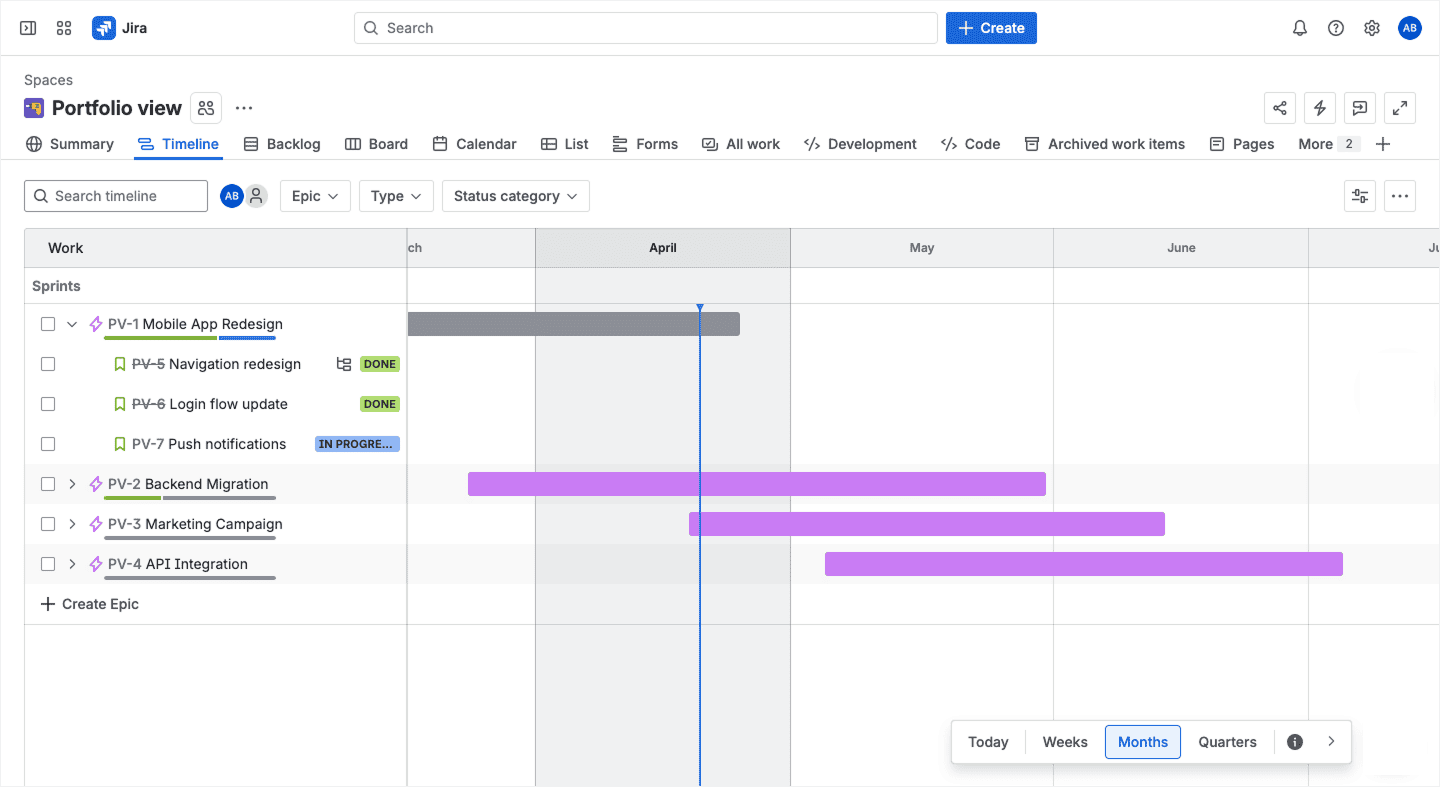
To set it up, reconfigure the Epic issue type as a project container in a company-managed project. Add custom fields for whatever you track at the portfolio level: project owner, current status, risk management, strategic goal, or budget bucket. Open the Timeline view from the sidebar: epics with start and due dates line up across the screen. Your cross-project view is built from standard Jira features.
Where it gets complicated
The workaround holds up at small scale, but as the portfolio grows, some structural problems eventually start to surface.
- Permissions stop being granular. Permissions in Jira are assigned at the project level. As this setup puts all teams inside one project, any permission you grant on one team's board covers everyone else's work too. If you want to fence it to a single team, there is no way.
- Automations need babysitting. Any rule you write for one team requires a JQL condition to stop it from triggering on everyone else's Epics. Over time, those conditions stack up. In a large enough setup, something will eventually misfire.
- Exit cost is real. The data structure this setup produces doesn't map cleanly onto what Plans or any dedicated portfolio management tool expects. Every month spent on this structure adds to the migration bill.
What this portfolio view can’t tell you
This kind of timeline delivers the sequence of tasks, their timing, and the dependencies between them. Useful, but effective portfolio management demands more than that. We need to know who's overloaded, what breaks when one project slips, or whether the team has the bandwidth for what's coming next quarter. For capacity data, scenario modelling, and cross-project reporting, the price of admission is a Premium plan.
The Epics-as-projects workaround works well for small teams running a handful of projects. Past ten or fifteen, it starts fraying, and the data structure it leaves behind is a headache to untangle when you eventually migrate.
Add advanced PPM to Jira without upgrading to Jira Premium. Try Planyway (it's free).
What project portfolio management features do you get when you upgrade to premium Jira tiers?
Plans is Atlassian's advanced planning suite, included in Jira Premium and Enterprise subscriptions as an answer to project portfolio management software needs. It draws Jira issues from multiple boards into one planning layer. Here are the key features that are particularly useful for running PPM.
A single timeline across all your projects
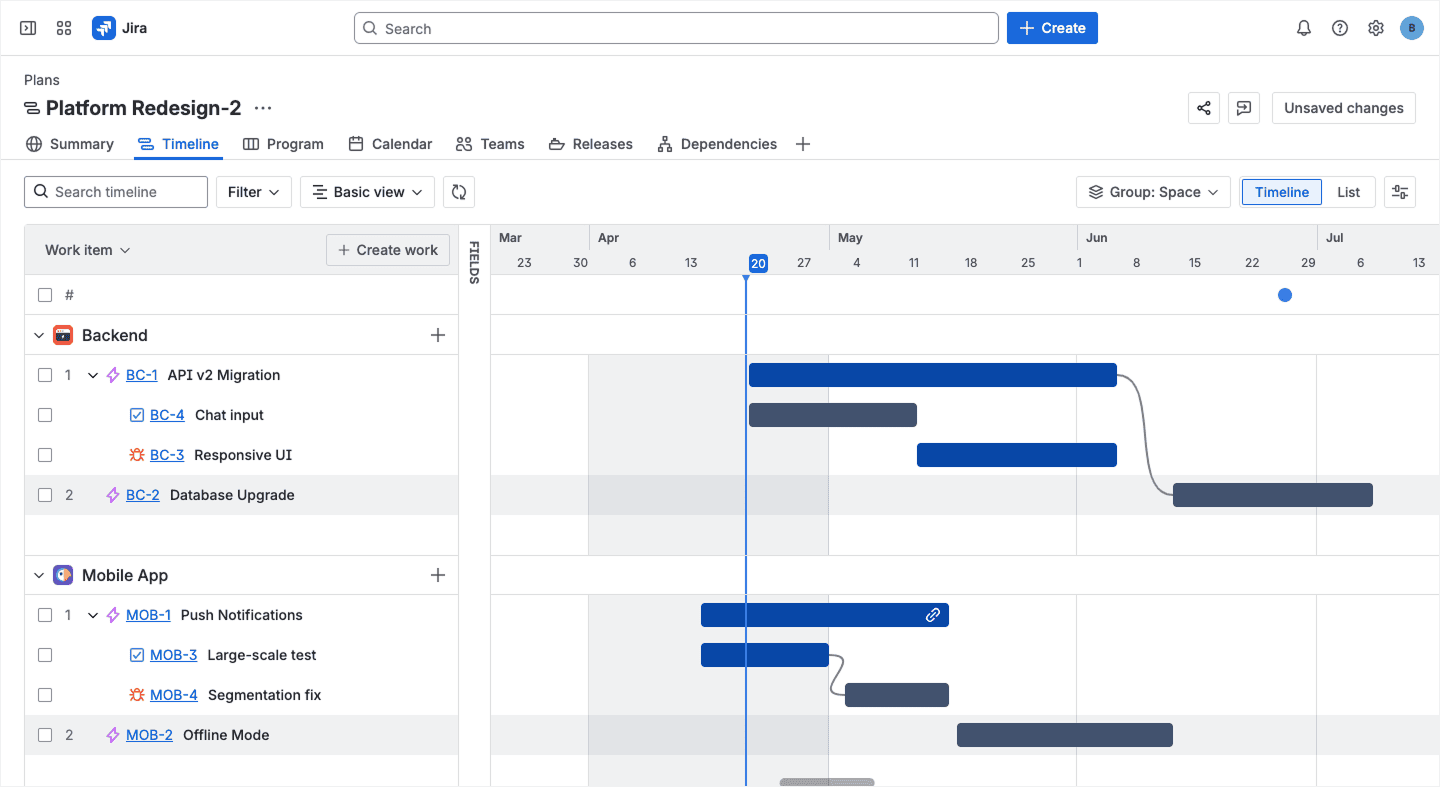
Plans pulls issues from boards, spaces, and JQL filters across a portfolio of projects into a single Gantt chart-style timeline. For a portfolio manager who fields weekly status questions from leadership, that's one place to track project progress instead of six boards open in parallel tabs. The timeline scales from weeks to quarters, with grouping options by teams, sprints, releases, or custom fields.
A hierarchy that reflects how you organize work
Plans lets you create custom issue hierarchies above Epic so the connection between daily work and strategy stays visible in one place. Initiatives, Themes, Programmes, and any other hierarchy level that matches your business process can be added above Epic. Initiatives, for instance, sit above epics and help projects align with broader organizational goals, which makes them a natural fit for the portfolio view. Leadership stays at the initiative level to manage strategic priorities, while teams move deeper — to epics and stories. And both layers live in the same plan.
Dependency mapping across teams
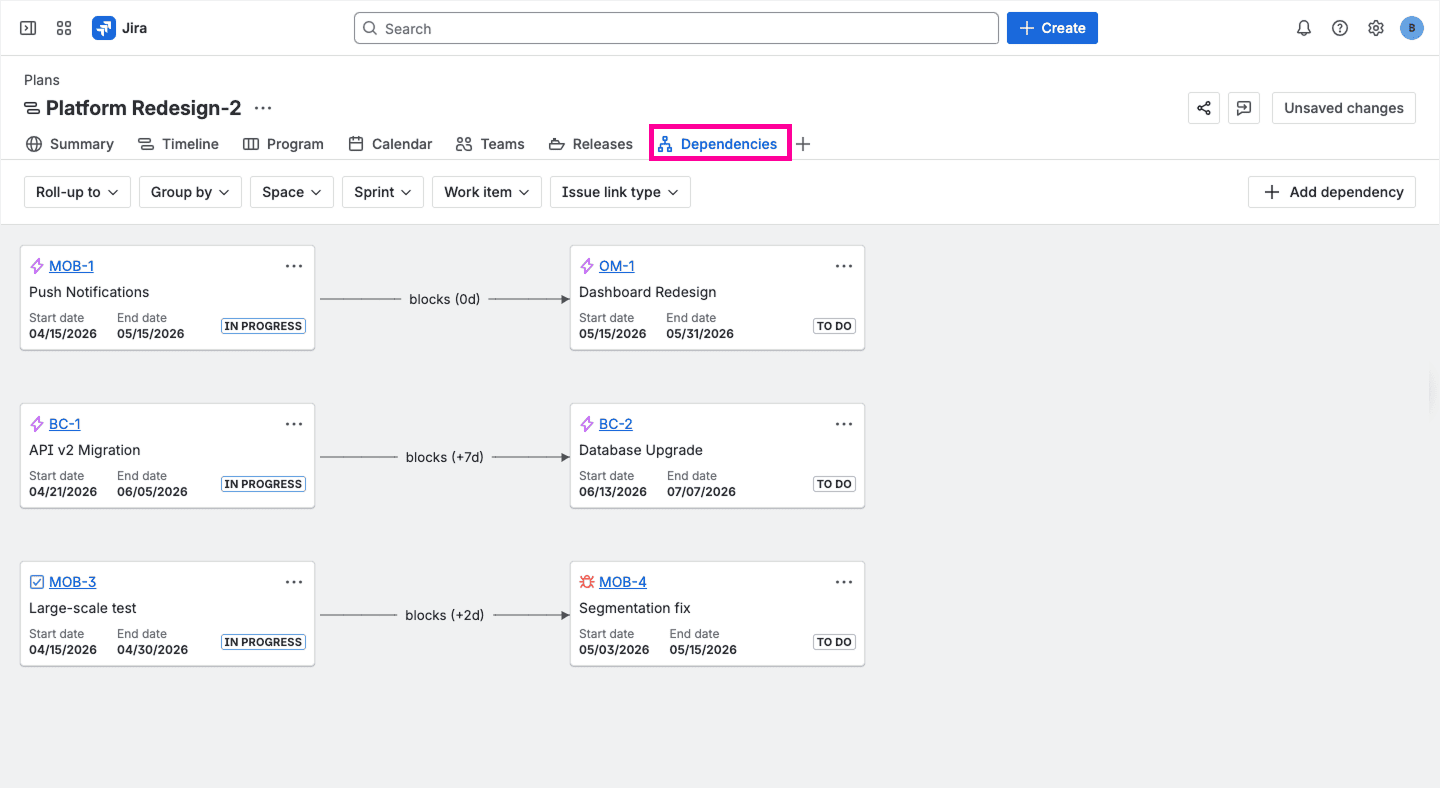
Cross-project dependencies are visible on the timeline as connecting lines between issues. When Team A's delivery is a prerequisite for Team B's sprint, Plans flags the misalignment early enough to meet deadlines. A separate Dependencies report tab maps all relationships across projects at once.
Scenario modelling before committing
Plans works as a sandbox. This means that changes stay inside the plan until you choose to commit them back to Jira. It's a useful tool for stress-testing the portfolio before making decisions. When you shift Project A's end date by two weeks and Plans immediately shows the downstream impact. That kind of visibility provides you with various scenarios already mapped and better planning.
Cross-project releases
When several teams need to ship a product launch or a programme increment together, Plans tracks that through cross-space releases. Multiple single-project releases align toward one shared date, so the dependency between teams shows up in the plan.
Stakeholder reporting
Plans lets you create filtered views of the same data for different audiences. For example, a leadership view is limited to initiatives, overall portfolio progress, and project performance. Conversely, a delivery team's view goes deeper to include epics, dependencies, and sprint detail. A saved view in Plans gives stakeholders access to live portfolio data shared as a Confluence embed, direct link, or CSV export. These reporting features cover most stakeholder communication needs.
Organizations that need pure-play enterprise-level portfolio and program management with SAFe support can purchase Jira Align, which is a separate product that, alas, comes at a hefty cost.
Core limitations of Jira portfolio management on premium tiers
Premium doesn't hand you an enterprise PPM suite. It hands you Plans, which covers a meaningful slice of the portfolio problem, but leaves enough gaps that most teams eventually go looking for other tools to fill them.
Resource management is team‑level only
Plans supports team capacity planning and resource allocation, but only at the team level. The sprint budget is one shared pool: story points or hours, set once, split equally across the team. When that bucket is full, the sprint bar turns red. Who specifically is carrying what share of the load, whether someone is part-time, on leave, or split across two projects — none of that is visible unless manually adjusted for each change. For sprint planning that depends on individual availability rather than team totals, that abstraction falls short.
No active workload planning
Plans is built for visibility and modelling, not hands-on scheduling. There is drag-and-drop, but it moves issues between epics or reorders them on the timeline — it does not let you assign individual tasks to a specific person by dragging them onto their row, stretch an issue to adjust its estimate, or see a red bar appear when someone tips past their daily capacity. There is no user-level workload view, calendar, or board, and no way to allocate resources at the individual level. The difference matters in practice: knowing that a team is overcommitted is not the same as being able to fix it on the same screen.
The plan goes stale
Every shift in availability — a day off, a priority change, an engineer pulled onto an incident — requires a manual update in Plans. Teams that move fast find that the plan drifts from reality within days of the last edit. At the end of the day, Plans gets reserved for the leadership view, while the actual work lives in a spreadsheet.
Not to say it will cost you a pretty penny, since there's no option to have part users on the Standard Plan and other users on the Premium Plan. So, if these gaps are deal-breakers to you or your PMO, or you don’t want to fork out for premium tiers, you might want to consider an alternative approach — which is complementing your Jira with dedicated project portfolio management software.
Planyway: a cross-project view that’s hard to find elsewhere
Let's say your team is somewhere between the worlds: native Jira project portfolio management tools don't cut it, but you also don't need a full-blown enterprise-grade PPM plugin that would take weeks to master. You're looking for something Jira-native — a project management tool that lets you manage individual projects and the full portfolio in one place.
Planyway is a Jira-native timeline and resource planning app that covers exactly that middle ground. It is wired for teams that run on agile practices but have outgrown the single-board view.
One timeline for all your projects
Planyway draws issues from multiple Jira boards and spaces into one Gantt chart-style timeline. Each project occupies its own lane, giving you a comprehensive overview of dependencies, milestones, and progress — all visible in one place across every lane. For a monthly portfolio review or a quick project overview, that's one screen to with aggregate data track progress across all the projects instead of six tabs opened in sequence.

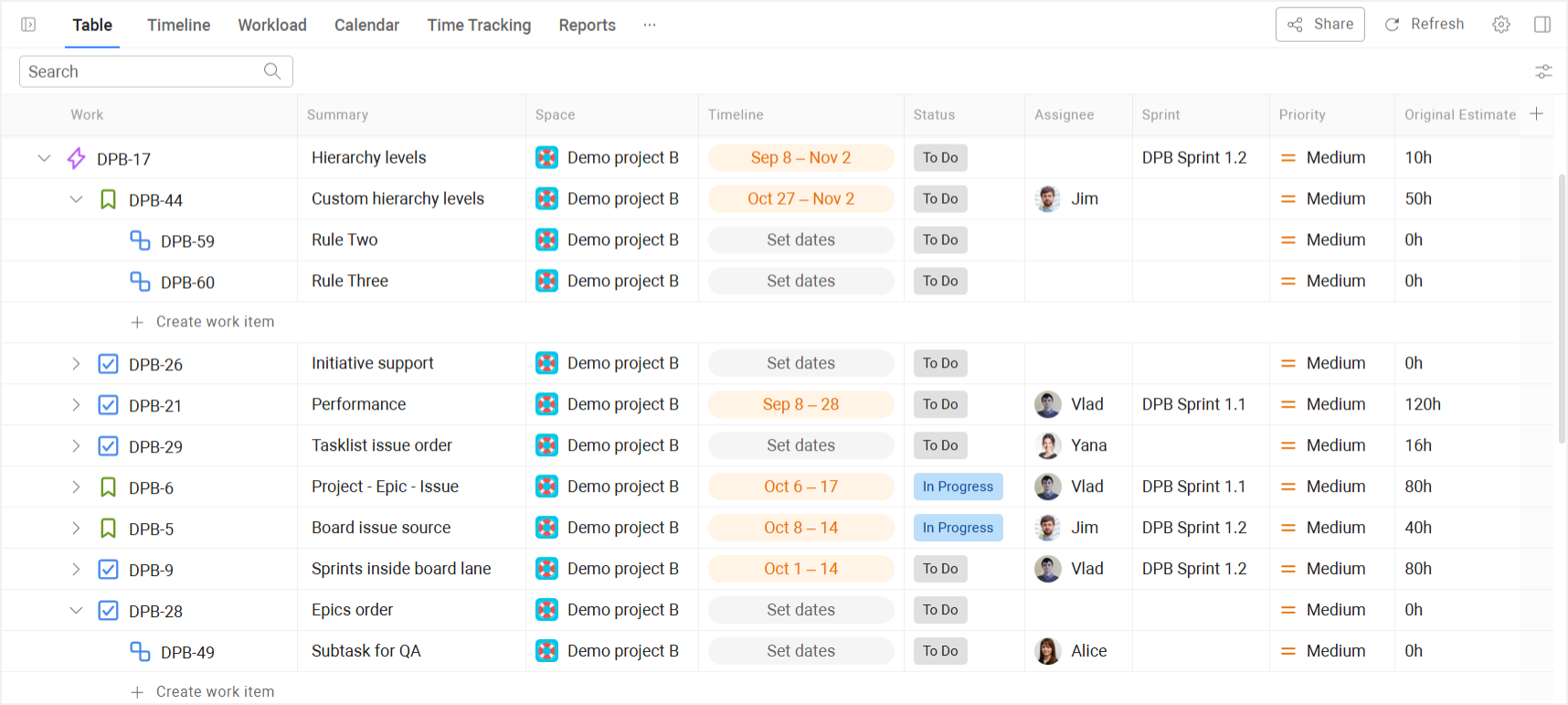
And when you need a more structured view of your work, our Table View gives you a spreadsheet-like way to review and manage Jira issues across projects.
Individual and team workload visibility across projects
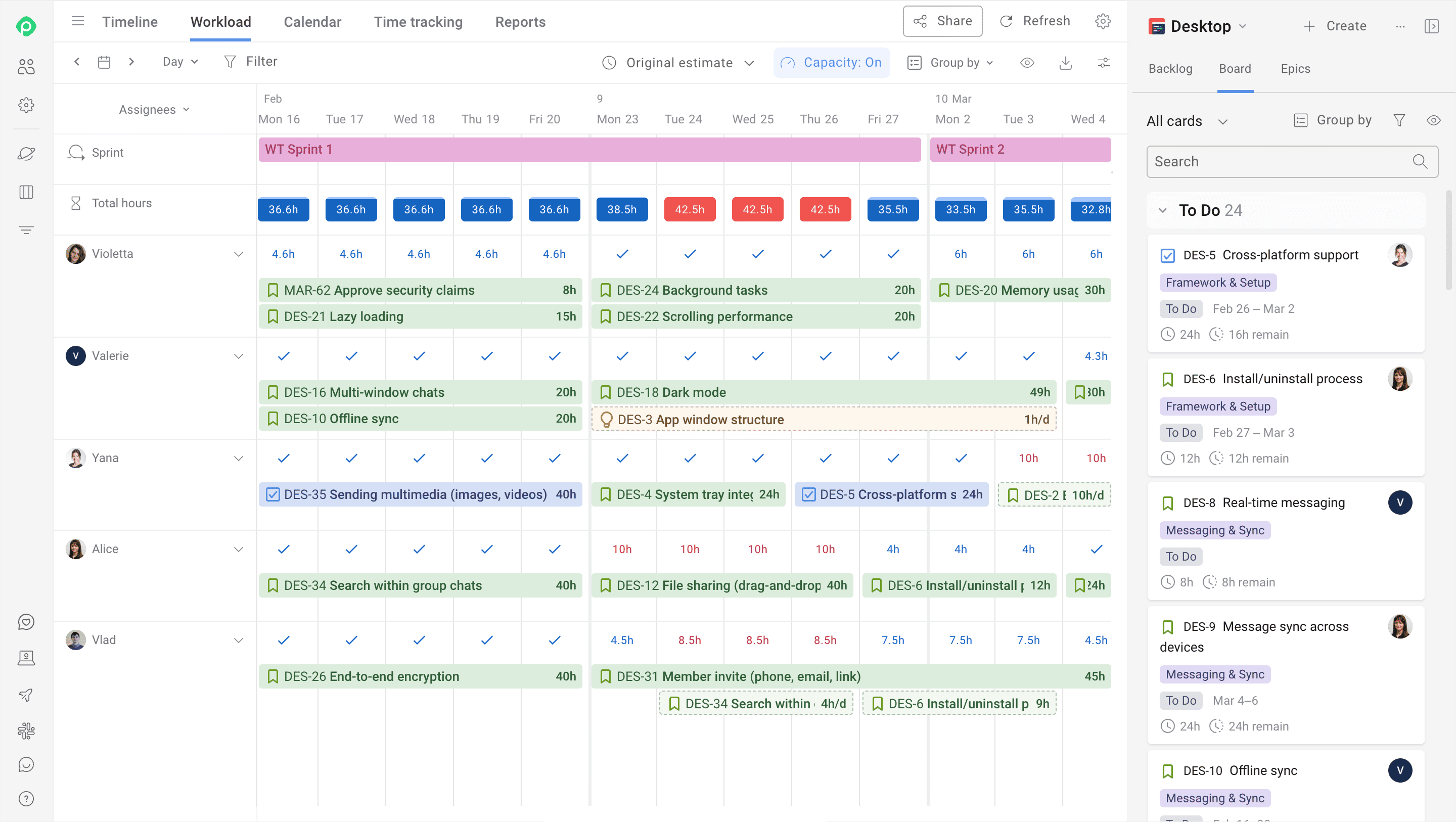
Planyway’s resource management goes beyond Jira Plans by showing workload at both the individual and team levels. Each team member has their own row on the timeline, making it easy to see who is assigned to what, identify overloaded users, and adjust plans before bottlenecks appear. When someone exceeds their available capacity, Planyway highlights the conflict so you can reassign or reschedule work directly from the timeline — with changes synced back to Jira.
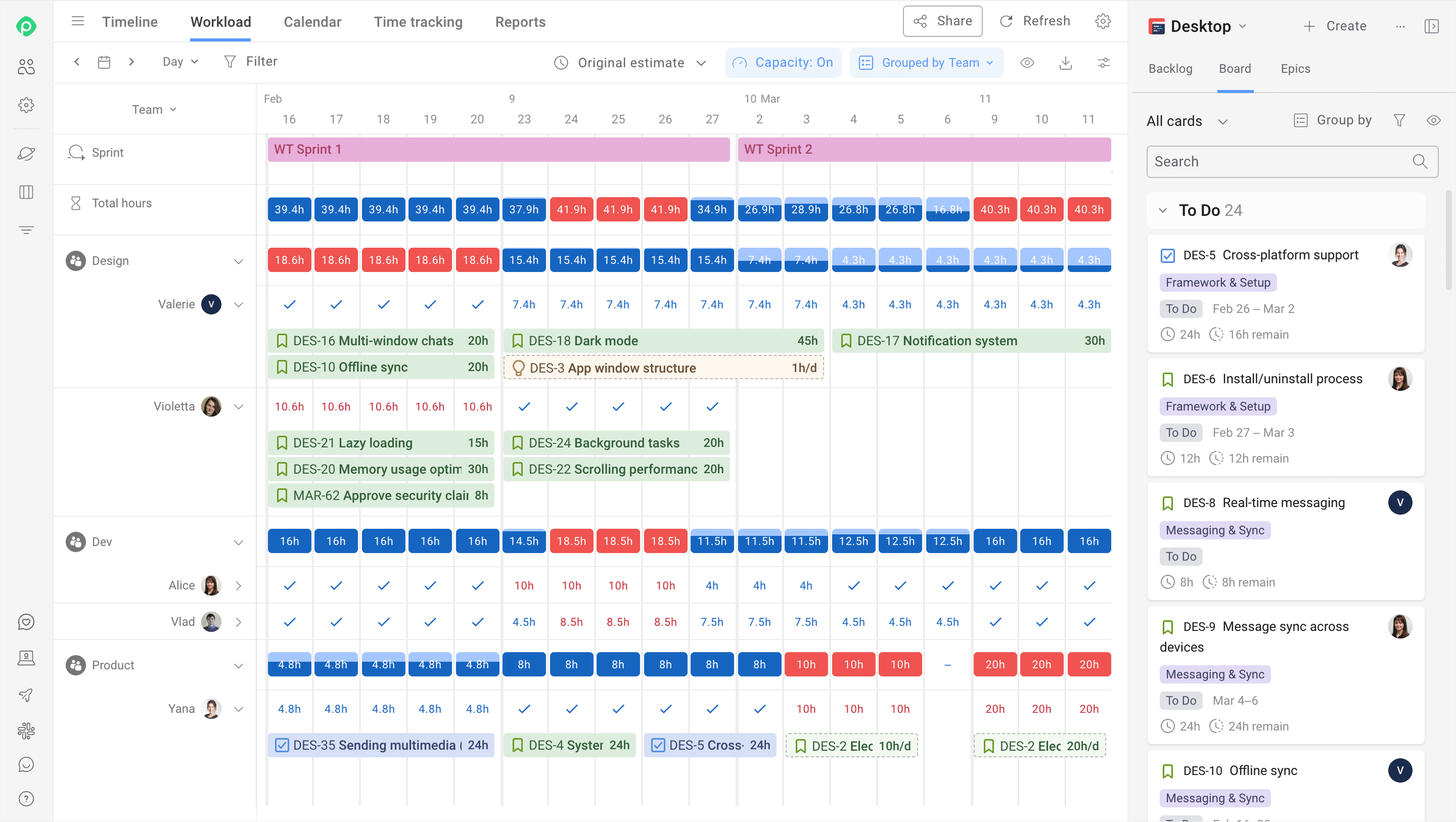
You can also switch the view from individual contributors to teams, turning the same workspace into a cross-team workload map. This helps project managers coordinate multiple teams around shared milestones, balance resource allocation across projects, and understand where capacity is available before committing to new work.
Seamless integration with Jira
Planyway lives inside Jira, drawing from the data your teams already produce and adding a visual layer that preserves operational efficiency. It closes the gaps Plans leaves open while teams keep working exactly as before.
Permissions sync automatically with Jira, so there’s no extra setup. Developers can stay on their boards, while project managers get a clearer view of progress, timelines, and workloads. You can also log time, monitor execution, and share a live portfolio view via a simple link — all without disrupting existing project workflows.
The big picture for your project portfolio, simplified
The data your team produces every day in Jira already tells the story of your portfolio and how it maps to organizational goals and strategic objectives. It shows what's in progress, what's at risk, who has room, and who is stretched. That picture exists in your Jira data — the only question is what it takes to surface it.
For teams that have outgrown the workarounds but have no appetite for enterprise-grade project portfolio management complexity, Planyway puts that picture one click away.


FAQ
Seeing all your projects on a single timeline in Jira requires a Premium upgrade or a Marketplace app. On Premium, Plans serves as Jira’s native management tool, offering a built-in cross-project timeline. Planyway is a Marketplace app that covers the same ground on any tier and adds individual workload visibility. Alternatively, users on non-premium tiers can use the Epics-as-projects workaround, which is free but structurally limited.
Jira doesn't have a native way to integrate tasks across multiple projects into one view, but there are a few approaches. A JQL filter spanning multiple projects, pinned to a dashboard, gives you a consolidated project status view. This option works well for a health check, but won’t show the sequence of work. Visibility into dependencies and execution order in Jira requires Plans on Premium or a Marketplace app like Planyway.
You can manage a portfolio of projects in Jira without Premium, but the options are limited. Jira's agile principles are built around single-team execution, and portfolio management in Jira was never part of the original design. The Epics-as-projects method and JQL dashboards are the two main Jira portfolio patches that work at small scale. Past five or eight concurrent projects, the manual overhead starts eating into the time the visibility was supposed to save. Native portfolio management in Jira hits its ceiling fast.
There are three common tools for resource planning across Jira projects: running a spreadsheet to track resources alongside Jira, upgrading to Premium for Plans, or adding a Marketplace app. Plans makes sense if you’re already on Premium and need structured cross-project planning and visibility at the team and portfolio level. Marketplace apps like Planyway provide similar cross-project resource planning capabilities (plus individual-level tracking) without requiring a Premium upgrade and often at a lower cost. The spreadsheet is where most teams start — it holds up until the portfolio grows past it.